Blog

Max Health And Fitness
Tampilkan postingan dengan label How To. Tampilkan semua postingan

sitting at desk

Whether it’s from your desk job or just a really long drive, you can ease those aches with these expert-recommended exercises.

You know that feeling—probably around 4 P.M.—when everything from your shoulders to your hips starts ache and tighten? There's both good news and bad news about what's going on.

The bad news: "We have a webbing of connective tissue called fascia that runs throughout our body and helps muscles work together," says Rebekah Rotstein, a movement educator and Pilates instructor in New York City and founder of Incorporating Movement studio. "It only glides and slides smoothly, though, when it's healthy and hydrated." It's quite common for that fascia to become dense and stiff, especially when you're dehydrated, don't move enough or have poor posture (read: when you're hunkered down at your desk all. freaking. day).

The good news: When it comes to generalized low back pain (as opposed to pinpointed pain, which could be a sign of a problem like a slipped disc—see a doc if that's the case), Rotstein says you can change the holding patterns in your muscles and fascia that are causing stiffness and discomfort. You just need to make a little effort.

But that doesn't necessarily mean to loosen up. "People often mistake tightness as a sign that you need to stretch," she says. "But many times, it's also a sign that an area needs to be strengthened." For instance, your abs should take some of the strain off the back as well—but when they're not strong enough to stabilize your core, the low back gets the brunt of it. Also, getting a stronger upper back, glutes, hips and shoulders can nix the aches because they'll redistribute the forces on your body and remove the excess strain from your back.

Feel better now with Rotstein's top four moves for releasing tension, strengthening your entire core and opening your hips.

1. Sky-High Stretch: Stand with feet together and extend arms overhead. Grab left wrist with right hand and pull gently as you stretch upward and to the right. Hold for 15 seconds, then repeat in the opposite direction.

2. Pelvic Tilt: Lie faceup with knees bent and feet on mat. Exhale and slowly rock pelvis up, flattening back against floor. (Your belly should sink as you do this.) Inhale and rock back in the other direction. That's 1 rep; do 10.

3. Knee Lift: Start on all fours with toes tucked. Inhale and lengthen through crown of your head while you look at the ground. Raise knees off floor a few inches; hold for up to 30 seconds, then lower. Repeat one to two more times.

4. Hinging Side Lunge: Stand with feet hip-width apart. Step a big step to right with right foot; push hips back and bend right knee to lower into a side lunge while keeping left leg straight. Push through right heel to stand and repeat on opposite side. That's 1 rep; do 10.

Photo courtesy of SELF.


Banquet lunch break at conference meeting.

Whether you are facing a full-on brunch buffet or a catered dinner smorgasbord, buffets can be a huge challenge for anyone who is trying to eat healthfully or, in the case of that irresistible mac-and-cheese goodness, keep portion-control in check. like me, when i see buffet i can’t hold any of my healthy eating habit that i’m just go uncontrolled to the buffet table and just eat and take all the stuff on the table.

The good news is buffets don't have to lead to feelings of regret and a blown calorie budget. Use this simple five-step strategy the next time you find yourself in that "all you can eat" atmosphere.

1. Don't go to a buffet feeling hungry.

hungry-girl

Buffets often trigger an "I don't want to be in control" feeling, and hunger will only intensify that. Being faced with dozens of tempting foods all at once is not easy for anyone, but if you have a history of struggling with overeating, a buffet can feel like a minefield. Heading into a difficult food situation feeling ravenous will simply make it exponentially more difficult to be in control.

2. Breathe.

breathing-picture-right-in-the-face

If you notice a lot of chatter in your head and powerful urges to eat everything, redirect your attention to your breath. Take long, calming inhales and exhales. Redirecting your attention to your breath is a powerful mindfulness technique that will help you feel more grounded and in control.

3. Assess the food situation.

look-at-the-food-its-suspicious

Before you start filling your plate, do a thorough walk-through. Take your time, and look at everything being offered. Is there a dessert section? Is there food you love and don't typically get to have? What looks especially enjoyable or has been prepared in an interesting way? What smells especially good? If you start to feel overwhelmed and anxious, you can always fall back on those calming breaths.

4. Choose your Top 4.

choosing-cookie-eat-cookie-two-girls-one-cookie

When you have finished the walk-through, mentally make a list of the Top 4 most appealing choices. Which four stood out to you? Which foods are you still thinking about? Which tastes/textures are you most wanting to experience? The four that keep popping out at you is your Top 4 list.

Notice what you are feeling; if it's very intense and you are struggling to narrow down your choices, add a small loving mantra to your breathing. The mantra should sound like you are talking to yourself in a supportive way. Such as: "It is hard to choose, I know how much you want it all, I hear you"; "You are doing so well"; "This is hard, you are not doing anything wrong"; "I am proud of you, and I love you." I know this might feel a bit strange and awkward, but give it a try and see what happens!

5. Go get 'em … and then get seconds!

suspicious-looking-austism-kid

Now it's time to enjoy! Start by getting two of your Top 4. While you spoon the food onto your plate, keep focusing on your breath and gently remind yourself to keep the portions small. The goal is to experience and enjoy a variety of foods instead of heading straight into a binge. When you sit down, eat slowly and enjoy the taste of your choices.

It's a buffet, so when you are finished go ahead and have seconds! Now's the time to sample your remaining two choices! Continue to slowly enjoy what you are eating, notice how you are feeling, keep refocusing on your breath, and repeat the supportive mantras if needed.

6.Silently watch your healthy habit

buffet-tower-no-tower-at-all

If, when you finish, you notice lingering thoughts of wanting more or distracting urges to keep on eating, gently acknowledge them. Work toward resisting the urge to overeat by tuning into what's going on around you in the present. Notice the weather, conversation with friends and family, the music that is playing. Stay observant and kind to yourself.

By following this five-step strategy, you'll be able to enjoy the buffet experience while reducing any overwhelming feelings you may have in this situation using simple mindfulness techniques and self-love. You may be surprised by the power of being gentle and loving with yourself.


No Secrets to Weight Loss How Victoria Wagar Lost 164 Pounds

For 32-year-old administrative assistant Victoria Wagar, a trip to Disney World 10 years ago unexpectedly changed her life. During that trip, she had been ordered off a roller coaster at the famed theme park when the safety bar wouldn't close. She was simply too big. But, when she recently planned another visit to the amusement park, this time with her 4-year-old daughter, there was no way she wanted that to happen again.

With that trip to Disney World on the calendar, she decided it was finally time to make a change. For someone who had been overweight for as long as she could remember, shrinking her 350-pound frame wasn't a simple proposition.

"There wasn't a day that went by that I didn't think about the fact that I was overweight," she remembers. "I always compare it to any addiction: I couldn't stop eating and always made the choice to eat the wrong things, even though I knew it was wrong."

Despite the odds, Wagar has managed to lose a whopping 164 pounds in a little less than a year and a half. This wasn't the result of a trendy diet, an expensive gym membership or even surgery. Wagar's key to weight-loss success was a direct result of educating herself about healthy habits and tracking every food she ate and step she took. Here's how she did it:

1. Create a Snowball Effect of Good Decisions

After signing up for MyFitnessPal in March 2014, Wagar dove headfirst into learning how to lead a healthier life. "I used the site, read the blogs and took tips from those," she says. "I gradually added more fresh fruits and vegetables, but it didn't happen overnight. I found that one good decision leads to another."

With a better understanding of the types of foods that would help her lose weight and achieve greater health, she also cooked recipes featured on the site. What's more, as she honed in on the healthier foods that she liked the most, she also started creating her own recipes. By entering them into the recipe nutrition calculator, she was able to determine overall calorie intake and serving sizes. "I know too much to ever go back now," she adds.

2. Initiate a Logging Streak

Previously, Wagar never had any idea of how much and what kinds of foods she should be eating, much less a daily calorie goal. Over time, she was able to determine what made sense for her as an individual. In order to make sure she was hitting her goals, she found that logging her meals was imperative.

"I've logged in for more than 500 days in a row now," she says. "When I started losing weight, I felt so good, so that was a major incentive."

Even in those early days before she made any big changes to her diet, she said that logging came in handy. "The first couple of times I put food in the log, I couldn't believe the calories," she explains. "Even if you're not going to change anything, get in there and log what you're eating and it'll really make you think. Sometimes I even use it as a research tool by putting something in to see how many calories it has before I eat it."

Wagar discovered that logging exercise was equally motivating. While she could initially walk around her neighborhood only one block at a time, she has progressively been able to add time to her walks as the weight came off.

"Holding yourself accountable no matter what is key," she says. "I really recommend tracking your steps so you can see how much you've moved. Now my day isn't the same if I don't work out."

3. Prioritize Caring for Yourself

Along with increased motivation came self-control for Wagar. "I had to tell myself that if I can get up every day and brush my teeth, I can do this: I'm worth it. I'm going to choose to take care of myself," she says.

She found greater self-control by planning ahead. She now goes to the supermarket with a list for the week's groceries so she's not caught in a moment of hunger without healthy options. On Sunday nights, she has fruits and vegetables cut and ready to eat, dinner in the Crock-Pot and lunches packed for the week.

To be sure, her newfound healthy lifestyle doesn't mean that she never eats the foods that she once loved. "I will have a burger at a cookout, for instance, but I will also bring a caprese salad and load up my plate with that," she says. "Even if you do have a bad day, you still have to hold yourself accountable; log it, and move on."

As someone who has waged a lifelong battle with weight issues, Wagar hopes that her story can serve as inspiration to others. "People always ask, 'What's your secret?' But it's not a secret. It's diet, exercise and MyFitnessPal," she says. "It has really changed everything—every relationship, my job. I'm just so happy."


lemons

Put down that energy shot! There’s no need to chug crazy canned concoctions or buckets of coffee to get through the day without a 3 p.m. slump. We found 28 quick and easy tips to up energy levels—no unpronounceable chemicals required.

1. Work out midday.
When that mid-afternoon urge to doze rolls around, hit the gym instead of the sack. Studies suggest working out can actually increase productivity enough to counteract that time away from the office.

2. Power nap.
Avoid the temptation to pull a Rip Van Winkle, and take a quick midday power nap instead. Studies show the optimal amount of sleep is 10 to 20 minutes to get through the day without throwing off the night’s sleep.

3. Hit the candy bowl.
Sure chocolate’s got caffeine, but that’s not the only reason it offers a quick pick-me-up. Flavonoids found in cocoa have been shown to boost cognitive skills and improve mood.

chocolate bar

4. Drink some joe.
We can say from experience six back-to-back cups of coffee is a recipe for instant crash-mode. But one cup is usually just right. One study found that a single cup of coffee was enough to keep sleepy drivers on a long haul more alert at the wheel.

5. Go outside.
Head into the great outdoors—even if some woods aren’t nearby, a green park will do. Just 20 minutes outdoors is enough to feel more alive. How’s that for an energy boost?

6. Eat regularly.
The body needs fuel (a.k.a. food) to function, and without it our energy and mood can spiral downward. However regular, healthy meals and snacks can improve cognitive function. But keep in mind not getting enough sleep can also cause us to eat when we’re not actually hungry, so check in with that stomach before munching down.

7. Reach for complex carbs.
Wondering what to eat to fuel up? Complex carbs (like whole grains) are a good bet. The dose of glucose they provide serves as food for the brain, and one study found a meal of complex carbs made subjects feel more energized. Studies have also found low-carb dieters to be moodier than those who do eat carbs.

8. Sip sugar-free drinks.
Studies suggest sugary energy drinks can leave us crashing as soon as one hour later. The shocker: The effects are the same even without the caffeine! That’s right, caffeine-free sugary beverages can cause a crash, too.

9. Stretch it out.
Just a few desk stretches may be enough, but studies have suggested a little yoga could fight depression and anxiety or other stress-related disorders.

downward dog

10. Add some greens.
In a stuffy office, a houseplant can help filter out pollutants like volatile organic compounds (or VOCs for short) and ozone. And those chemicals can have both long and short-term effects, including energy-draining allergies and headaches. Add a plant, though, and those threats could diminish.

11. Laugh.
Laughter’s a proven stress-buster, but studies suggest laughing can boost energy levels, too. (Feel free to use this as permission to go on YouTube for the next 30 minutes.)

12. Open the curtains.
Environmental cues play a huge role in thebody’s energy grooves (a.k.a. circadian rhythms), and sunlight can also help alleviate seasonal affective disorder. But there’s no need to invest in a light therapy box if there’s a sunny window available.

13. Chew-se wisely.
Instead of nodding off during an endless meeting, eat a small piece of candy or pop a piece of gum. One study found chewing gum can increase alertness and improve mood.

14. Think fast.
It may not sound so easy when those eyelids are drooping, but making the brain work a little quicker may help the body follow suit! Thinking faster (i.e. reading at a quicker pace, brainstorming in a group, or learning a new concept) made one group of study subjects feel more energized.

15. Take a cold shower.
It’s all about the polar bear swim. Researchers have even suggested a three-minute long cold shower could be enough to counteract some of the effects of chronic fatigue.

16. Take a few deep breaths.
Nope, it’s not just the key to resisting the urge to scream at that stupid driver. Deep yoga breathing from the diaphragm gets blood pumping, which also may boost energy all day long.

17. Drink.
Whether at the gym or just dealing with the daily grind, it can be hard to remember to drink enough water. But even mild dehydration can cause sleepiness, so try chugging a glass or two when fatigue strikes. Or, better yet, stay hydrated all day long!

18. Flick a switch.
Circadian rhythms can have a big impact on how alert we feel, but one study found feeling more awake (at any time of day) can be as easy as flipping on some lights.

19. Turn up the volume.
Don’t just turn on to tunes to chill out. Listening to music and tapping those toes significantly increased college kids’ alertness in one study.

listen to music

20. And sing along.
Even Dummies know singing requires breath control. Belt it for a full song, and there’s plenty of extra oxygen pumping to feel energized as well as the adrenaline of taking it to the (karaoke) stage. Plus, one study showed singing significantly increased energy levels among college students (more than just listening quietly to tunes).

21. Do something interesting.
Plan to do the most engaging or interesting task of the day during the sleepiest time of day (typically around 3 p.m.). One study found that being interested in a task makes it significantly easier to stay awake (despite an energy lull).

22. Adjust the temperature.
Being too cold may cause the body’s temperature to drop, which tells it “time to sleep!” Throw on a sweater or turn up the heat to fight off that drowsy feeling.

23. Choose the window seat.
Consistently dozing off in class or meetings? Move closer to a window. The daylight, fresh air, or even simply a natural view can all help boost alertness. On the flipside, a frantic street view may make it harder to focus.

24. Be social.
Studies have found people who are less social are generally less happy and don’t sleep as well. And compared to sedentary or quiet office work, chatting it up made study subjects feel more awake.

25. Seek some lemon-aid.
Sniffing certain scents (a.k.a. aromatherapy) is rumored to have all kinds of mood benefits, but lemon oil is one of the only essential oils with proven support. Lemon is considered a stimulating scent, and one study showed it improved subjects’ moods.

lemons

26. See red.
Studies have shown the color red is associated with winning and self-confidence. Try looking at some red or violet hues (or wearing them) to feel more awake.

27. Straighten up.
Slouching over the computer could cause fatigue earlier in the day. Sit up straight, though—that’s shoulders back, eyes dead ahead, and lower back slightly arched—to feel more energized and possibly even get a boost of self-confidence.

28. Leave the desk.
Chowing down in front of the computer makes overeating even more likely. But getting away from the desk at lunchtime could help reenergize and refocus, too. Whether it’s a quick walk or a long lunch, take some time to wake up away from the glowing screen. Those emails can wait a few minutes. Really.

Photos courtesy of Greatist.


5 injury prevention tips for new runners photo
Running is universally recognized as one of the healthiest forms of exercise and can yield powerful results for your body, making you more fit, healthier and happier. Once you get into the habit of running a few times a week, you'll soon notice how quickly running can get you into shape. You might also notice that the high impact, repetitive nature of the sport can take its toll on your body. This is the point where many brand-new runners give up.
But if you're patient and learn how to balance running just enough to progress without overdoing it, your body will start adapting and you'll reap the benefits of improved fitness. Here are 5 tips to help you find that happy medium while also avoiding injury:
1. Progress gradually.
There are 2 main reasons people get injured from running: They run too much too soon, or too fast too soon. Even experienced runners who know this rule frequently break it while trying to push their bodies too hard. Start out slowly, and progress gradually.
One age-old rule is don't increase your weekly mileage by more than 10% per week. This rule applies whether you're trying to stick to a run/walk program, progressing to running 3–4 days a week or training for a 5K. Your muscles will adapt to the stress of running, but they need time to do so.
Another good rule to follow: Make sure your longest run of the week isn't more than 50% of your weekly total. So if you're running 15 miles total in a week, your longest run should be 7.5 miles max.
2. Rest and recover.
Proper rest is just as important as your training. You can't improve if you don't allow your body to recover. It's a simple sentiment, but it can sometimes be tricky to execute. If you're not used to running every day, don't start a training plan that requires you to do so. Rest days are critical to keep you healthy while you progress toward your goal.
3. Buy the right shoes.
If you're new to running and feel overwhelmed by the seemingly endless styles of shoes available, take a deep breath and read on. The first step to finding your perfect shoe is to figure out what kind of stride you have. If you're a heavy "over pronator," which is a term used to describe how the arch collapses as your foot contacts the ground, you may need a shoe with support. If you have a neutral foot strike, you likely don't need additional support and can run in a neutral shoe.
The best way to determine what kind of foot strike you have is to seek advice from a knowledgeable source, like a salesperson at your local running specialty shop. There are dozens of support and cushion levels that vary from model to model and brand to brand. The best way to figure out what works best for you is to try shoes on and run in them. You should be able to find a perfect match with a little knowledge and patience.
4. Roll it out.
Post-run stretching and massage can help your muscles stay loose and prevent imbalances. Think of self-massagers like floss for your muscles. It's a bit of a chore, but doing it every day can keep you healthy. How much you stretch and incorporate massage into your daily routine will depend on your body and how it adapts to the stress of your training.
5. Maintain balance.
As you increase mileage, it's important to keep track of the other parts of your life that can cause stress and contribute to injury. Are you getting enough sleep? Are you eating enough calories (and the right type of calories) to keep your body fueled and energized? Are you eating a healthy, balanced mix of foods? These lifestyle decisions go hand in hand with your training.
You may not associate your diet with knee pain, but if your diet is poor, your immune system could be compromised. This can result in longer recovery time between workouts and eventually contribute to an injury.
Running is perhaps the purest form of exercise and can be one of the most enjoyable. To stay injury-free and running happily, remember to ease into your training, learn how to recover, buy the best shoes for your feet and, most importantly, maintain balance throughout your life.


ASK MANX: How many carbs and protein should I be eating post-workout? You like waixy maize? –BORN

When I first started training, there was nothing I looked forward to more than my post-workout meal. It was the time when my muscles were starved for food. But more importantly, I thought it was a time when my body needed a massive insulin surge to take carbs and transform them into hard earned muscle.

What you eat after a workout is less important than meeting your overall calorie and macronutrient guidelines for the day.

In my mind, insulin meant sugar, and sugar meant Frosted Flakes. (And lots of Frosted Flakes, as in several very large bowls.) After all, I was convinced my body was like a sponge after a workout and would soak up all the carbs.

Turns out, my mindset regarding the need for significant carbs after a workout was misguided. Of all the ingredients involved in building the body you want, there's a certain mystique about the role and importance of the meal you enjoy after your workout.

There's no shortage of information and opinions on what you should eat, how much you should eat, the importance of the timing, and the dangers of what you risk by not emphasizing this meal. And while timing is not insignificant, the latest research indicates that most what we thought was true about the post-workout meal no longer holds as much accuracy.

One of the most common suggestions revolves around the consumption of carbs after your exercise session. While consuming carbs after a workout is perfectly fine—and carbs are necessary for muscle growth—our bodies don't need as many carbs as we think. More importantly, we don't need to load up on simple carbs (think sugar) in order to refuel and see changes.

The New Rules of Post-Workout Meals

The biggest problem with focusing on what to eat after your workout is that we tend to view this meal in isolation. Instead, it's best to be aware of what you had before your workout, or if you train in the morning, what you had for your last meal before you sleep.

Your body doesn't run on a short-term fuel supply. Your glycogen (muscle energy, if you will) is filled up anywhere between 350 to 500 grams of carbohydrates. If those numbers don't mean much to you, that's more than enough fuel to get you through your weigh workout; and plenty for most endurance sessions, too.

Your goal is to promote muscle protein synthesis (muscle growth and repair), and for that to happen, you don't need a massive insulin spike. In fact, research has shown that a moderate amount of protein and carbs (or even protein alone, more on that soon) can max out the muscle protein response after exercise.

In this study, scientists found that insulin is "permissive rather than stimulatory.” Instead, it's to make sure you activate insulin and allow it to do its job.

Translation: the goal isn't to jack up insulin to see a greater response.  More carbs and insulin is not better and does not accomplish more.

Pre-Workout v.s. Post-Workout: A Team Approach

This certainly differs significantly from the general ideology passed down from some supplement companies. The commonly held belief is that if you don't use fast-acting carbs immediately after a workout, then you won't elevate your insulin levels, you won't recover, your body will shrink, and all potential gains will be lost.

Your body isn't carb-dependent because post-workout because you ate before your workout can have a big impact.

In fact, a pre-exercise meal can help ensure that your insulin levels remain elevated up until your workout is over. If you eat protein and carbs before you train, insulin can remain elevated for several hours. And if you don't like solid foods, combining 6 grams of essential amino acids with about 35 grams of carbohydrates can keep insulin levels about four times higher than fasting levels for about two hours.

This isn't to tell you must eat before you train (it's completely goal dependent and also a matter of how well you digest food before you exercise).

Instead, it's to emphasize how easy it is to create an insulin response that will help your body before, during, and after training. And more importantly, it allows you to know the flexibility involved in choosing what you eat before or after a workout without having to worry that you must follow a specific plan that might not feel right for you. (This is something I’ve tested with clients and have found to be much more beneficial than rigid plans.)

Insulin's ability to prevent muscle protein breakdown and maximize muscle protein synthesis isn't dependent on massive amounts of carbs (because you're not completely depleting your glycogen stores), and doesn't require a special carb blend.

This is another instance of people majoring in the minor. The, "I need magical fast-acting carbs from waixy maize within 30 minutes of training" is not as important as focusing on the bigger picture. In this case, making sure you have some protein and carbohydrates after a meal, and focusing on a good overall diet.

Whereas many people believe that the 5 percent is where winners are made, it's really where the most stress occurs, arguments erupt, and progress can be stalled.

Master the big picture details first, and you're likely to see more results, have better compliance, and achieve much better clarity. Then you can tackle the most specific details.

What You Should Eat Post-Workout

The urgency of a post-workout meal is significantly exaggerated. Moreover, most research with glycogen depletion and repletion focuses on endurance athletes. If you're a runner putting in serious mileage, for instance, your need for glycogen-replenishing carbs is greater but still not urgent—and it's on both ends of the spectrum.

Most people who have exercised are familiar with the concept of carb-loading. And yet, research published in the Journal of Applied Physiology found that bumping up carbohydrates to more than 50 percent of their diet (and maxing out at 75 percent) didn't improve muscle glycogen and only led to a minor 5 percent improvement in their performance. In other words, all those extra carbs are not worth it. (Although the meals might be enjoyable.)

When it comes to weight training, your body is in even less of a need for the instant carb surge. That's because most weight workouts—even the more aggressive approaches in the 45 to 60 minute range—won't come close to depleting your glycogen stores.

And if you do eat a preworkout meal, that need is even less as the food you ate beforehand is most likely still being absorbed by your body even after you've finished. What's more, even if you don't eat carbs before a workout and skip them in the time period immediately after you train, as long as you eat carbs several hours later your body will still recover and glycogen resynthesis will occur within about 24 hours. (Yes, the body is an amazing machine.) Consider this good news as the benefits of the post-workout meal period are experienced for a longer period of time.

The majority of the most recent research emphasizes that timing is less important than the total amount of food you eat, and the macronutrient ratios (of proteins, carbs, and fats) you consume.

That’s not to say eating after a workout isn’t important; rather, “after a workout” is just a much longer period of time than originally thought. In fact, the idea of the "small anabolic window" is minimized with each passing year (this is not a bad thing).

It now appears that your post-workout window is really open for about 24 hours rather than 30 to 60 minutes, with the first 4 hours being when you want to make sure you eat or have a shake.

That means more flexibility with your meals and not feeling forced to slog down a shake if you're not hungry.

Just as valuable is the research that suggests the increasing importance of protein after your workout. A study published in 2010 found that adding carbs (about 50 grams) to 25 grams of whey protein did not increase post-exercise protein balance compared to the protein without carbs.

As for carbs? Unfortunately the research just isn't as clear. This excerpt is from a research review in the Journal of the International Society of Sports Nutrition on nutrient timing published by Alan Aragon and Brad Schoenfeld.

It is tempting to recommend pre- and post-exercise carbohydrate doses that at least match or exceed the amounts of protein consumed in these meals. However, carbohydrate availability during and after exercise is of greater concern for endurance as opposed to strength or hypertrophy goals.

Furthermore, the importance of co-ingesting post-exercise protein and carbohydrate has recently been challenged by studies examining the early recovery period, particularly when sufficient protein is provided. Koopman et al 52 found that after full-body resistance training, adding carbohydrate (0.15, or 0.6 g/kg/hr) to amply dosed casein hydrolysate (0.3 g/kg/hr) did not increase whole body protein balance during a 6-hour post-exercise recovery period compared to the protein-only treatment….

For the goal of maximizing rates of muscle gain, these findings support the broader objective of meeting total daily carbohydrate need instead of specifically timing its constituent doses. Collectively, these data indicate an increased potential for dietary flexibility while maintaining the pursuit of optimal timing.

Lab to the Kitchen: Designing Post-Workout Meals

What does it all mean? There is no "perfect meal" for after your workout. While the post-workout time period is still important and valuable, when it comes to achieving your goals, what you eat after (or even before) a workout is less important than meeting your overall calorie and macronutrient guidelines for the day.

If you are someone who tracks calories or macros, your daily goals should be focus 1A and 1B. In general, days where you train you should eat more carbs, and days when you don't train you'll most likely have less.

From there, determining what to eat post-workout depends on your preference. If eating pre-workout leaves you feel groggy or sick to your stomach, some branched-chain amino acids or potentially fasting (research has shown that protein breakdown is elevated after fasting and eating after training while fasted can have a positive effect; or if you don't fast not eating 3 to 4 hours before your workout can be beneficial because a meal of protein and carbs can keep amino acid levels elevated for up to 6 hours) might be best for you.

But if you still need more direction for your post-workout meal, your top priority is probably protein. That's because research shows that if you eat protein any time around your workout (before, during, after) then you have a similar increase in muscle protein synthesis.

Anywhere between 20 and 40 grams of protein before or after (or both) should do the trick, and based on Aragon's research, a similar amount of carbs should work—although the science is not as definitive.

If you're worried about eating fat in your post-workout meal, well, don't. The idea that post-workout fat will slow down an "anabolic effect" of protein is unsubstantiated in any research. While protein and carbs are still the preferred nutrients, having some fat (think eating eggs) is not going to slow your process.

What you eat during the course of the day matters more than what you eat before or after your workout. In the post-workout meal prioritize protein over carbs, and when adding carbs understand there's no need for massive amounts to raise insulin. This is not an anti-carb approach. Instead, it’s a matter of realizing the lack of urgency for carbohydrates post-workout, and understanding that you don’t need to consume excess amounts of carbs to recover properly.


businesswoman with a note-book in a cafe drinking coffee

You know what you need to do to drop those extra pounds and be healthier. You need to wake up a little earlier. Walk a little bit more. Eat a few more servings of vegetables, and skip a few glasses of wine. You need to decide to do it, right? You need to set that alarm (and actually get out of bed when it goes off). Buy those green beans. Ask for club soda.

But what's stopping you? What are you afraid will happen?

In 1979, economists Daniel Kahneman and Amos Tversky discovered how important fear—or at least, the fear of possible loss versus the hope of possible gains—was to human behavior. They did a series of experiments that were published under the title "Prospect Theory." This theory describes the way people choose between alternatives that involve risk. The reality: We're irrational about loss—but predictably irrational.

Take this thought experiment: Bet on a coin toss. If you win, you win $150. If you lose, you lose $100. The probability of either outcome is 50/50, but the potential gain is 50% higher than the potential loss. Do you take the bet?

Traditional economics predicts that 50% of people would take that bet. Kahneman and Tversky found that the overwhelming majority of people would not take that bet.

And this holds up with just about everything involving risk. As Dan Ariely describes in his book "Predictably Irrational," "People hate losing much more than they enjoy winning." About twice as much, in fact. In order for 50% of people to take the coin-toss bet, the researchers had to increase the payout to $200.

What does this mean for your weight-loss journey?

When I was in school for health psychology, I had to learn the right kinds of questions to ask my clients, and my supervisor gave me a clear heuristic to fall back on: Follow the fear.

At first, this seemed extreme. I mean, we're talking about helping people with some pretty benign stuff. But every time I followed my supervisor's advice, my client had a little epiphany. Then another. Then another. Most of what was holding people back was not rational. Of course, we all know we need to eat less and move more. But that's not enough to get us moving. Because it's too rational. It's just the hope of gain. We need to weigh that against the very real, often unspoken fear that what we're doing might not work.

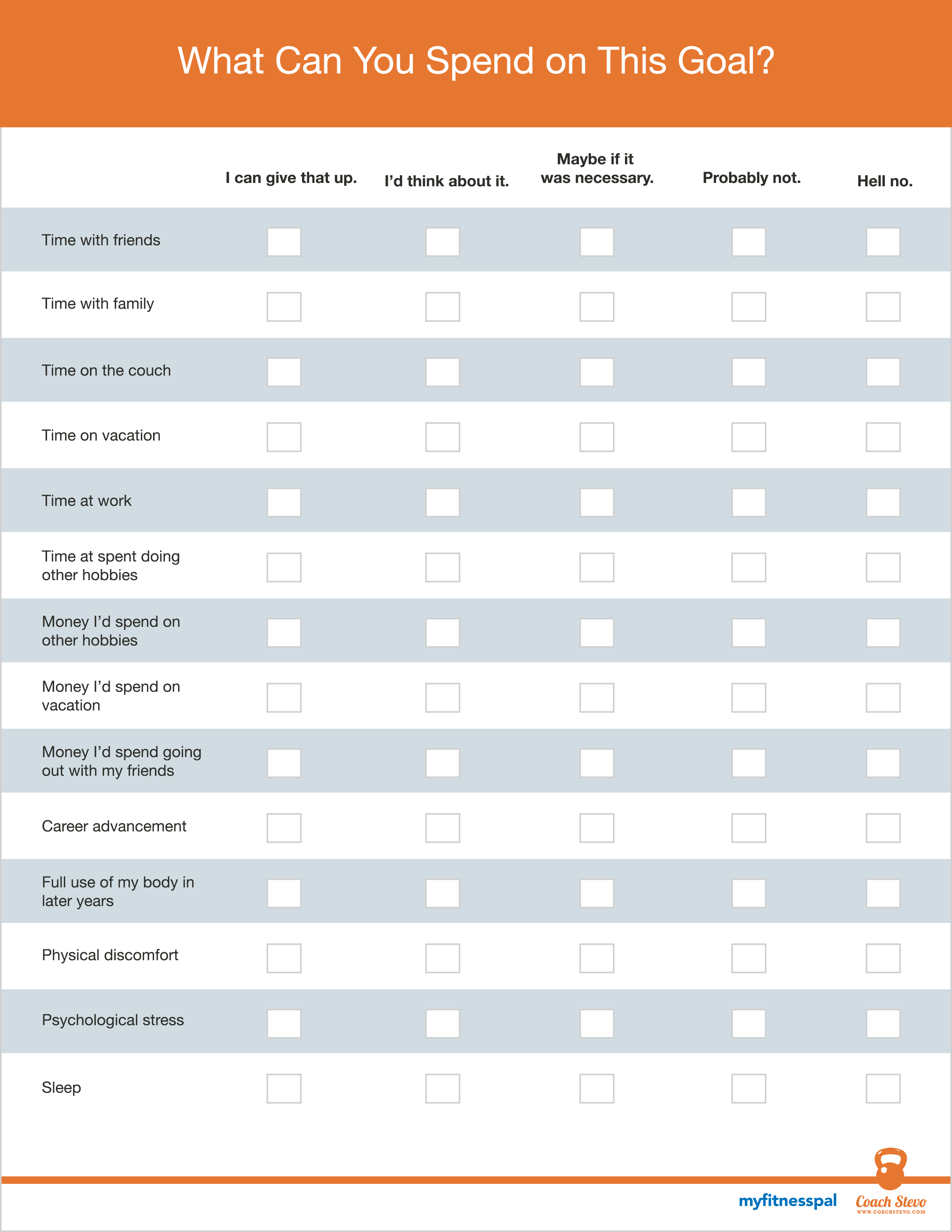
So, to do that, I use my priority grid:

Coach Stevo Priority Grid4

There are no wrong answers or minimum scores. In fact, the scores don't even matter. I don't even add them up. The only thing that matters to me in this initial assessment is that you take the time to think about and prioritize your answers. What matters is not the answers, but the thought that goes into them.

Most of what holds us back from getting the things we want is not that we don't want them enough, but that we're afraid that trying might not be worth it. So take the time to think about what you're willing to risk, and ask yourself, "What's the worst that could happen?"


Previous PostPostingan Lama Beranda
Related Posts Plugin for WordPress, Blogger...