Blog

Max Health And Fitness
Tampilkan postingan dengan label Plan. Tampilkan semua postingan

Beautiful girl is looking at unhealthy donut with appetite. It is situated on a table. Isolated on a white background

You had a hard day at work and feel like you need a reward. As soon as you get home, you reach for the cookies on your kitchen counter. You don't even think about it and just react. In the span of one minute, you inhale three cookies. You had an unpleasant experience and try to cope by reaching for a more pleasant experience.

In the past several years, I have consulted on research looking at the long-term benefits of mindfulness as it relates to weight loss, healthy nutrition, stress resiliency and greater well-being. One of the studies I consulted on observed the relationship between stress and eating. When we feel stressed, we often crave foods that are higher in fat and sugar because these foods reward us quickly with a release of dopamine or serotonin. These neurotransmitters promote relaxation to our stressed nervous systems. This is why we call them comfort foods.

Chronic stress—the kind that can come from a difficult interaction in a relationship or challenges on the job—can turn a switch that elevates cortisol secretion. This, unfortunately, promotes abdominal fat storage.

Want to learn how to be mindful of your stressors and cravings while losing belly fat? Of course you do! Mindfulness is simply paying attention in the present moment. When we slow down and pay attention to what is happening now, we cultivate greater awareness of our thoughts, feelings, body and needs. When we practice slowing down, our nervous system relaxes. We can more easily deal with all the ups and downs of life from a place of calm. This, in turn, diminishes cortisol secretion, leading to less abdominal fat. When we are mindful, we can tune into what we are craving and what is actually wise to feed in that moment. Here's how:

1. Learn to pause.

By learning how to be mindful of what we are hungry for, we can train the mind to notice but not automatically react, based on habitual patterns. In other words, we can notice we want the cookie but not eat it without thinking first.

2. Get enough sleep.

Research reveals that we aren't able to make the best choices about food when we are sleep deprived. I would also include that we are more irritable and have less ability to concentrate and focus, and our overall capacity to deal with life is diminished, when we have less sleep.

3. Learn to label your feelings.

Research has shown that labeling what we experience in the moment lessens our emotional reactivity to the stressor. All of our feelings have needs, so by tuning into your feeling, you can tune into what you need.

4. Surf the urge.

We have many different desires all day long, but if we acted on each one, we would be 2 year olds, not well-meaning, mature adults. If you really want something (sex, those new shoes, food, etc.), notice the desire and then ask, "Can I be with this desire for 20 minutes?" Yes, of course you can. Practice waiting, and if you still want it 20 minutes later, then go for it. What normally happens is the original desire isn't so captivating anymore, and it passes (then we want something else).

I teach about the relationship of mindfulness and cravings in the Blooming Lotus course; our August focus is mind/body health.  

5. Practice patience.

Much of our reaching for the pleasant is due to our impatience with the unpleasant. We can learn to build our patience muscle by slowing down and accepting what is.  I personally find impatience with traffic, so I have a little Post-it in my car that says, "Practice patience." This gentle reminder helps a lot when I do encounter traffic. We all know the saying, "Good things come to those who wait."

Listen to your desires, and see if you can practice surfing the urge. Let me know how it goes!


The Simplest Plan for Successful Weight Loss

If there is one fact that everyone knows in theory but not in practice, it's this: You're not perfect.

You're going to struggle. You're going to have bad days. You're going to eat more than you planned on eating, and you're going to feel like doing nothing sometimes. It's not a matter of "if." It's "when." And, after helping more than 1,000 people lose weight, I can tell you more than likely that "when" is Friday.

Friday is the most common day I see people get a case of the "screw its." When perfect is no longer an option, they just throw the playbook completely out the window. But these swings in consistency are death to long-term weight loss because they rob us of momentum.

So I started trying to come up with a better plan, and, luckily for all my clients, I'm a huge history nerd. In battle, great generals do not just tell their troops "charge" and, if things go badly, yell, "Run away!" Before troops ever go into battle, they pick a spot on the map to retreat to in case things go badly. This is their "Fallback Plan." After reading a bunch of books about the history of tactics in land battles, I developed "Fallback Plan Friday."

Your fallback plan is your line in the sand. Something you are 100% confident you can do, no matter what. It can be a nutrition habit like eating protein at every meal or an easy 15–20 minute workout that moves you toward your goal but requires as much thought as brushing your teeth.

A good fallback plan needs to be simple and easy, and it has to be bang for your buck. Start by writing down your favorite way to train or eat. Do you like barbell complexes? Salads? Kettlebell swings and goblet squats? Tae Bo? Anything is fine. Let me repeat that: Any exercise or nutrition habit you love is fine.

Now write down the bare minimum that you can do of that exercise or nutrition habit and still feel like you're making progress. Is it one salad at lunch? Is it drinking one less (sugary or alcoholic) drink? Doing 20 push-ups? And yes, I want you to underestimate here. I mean, really lowball it. The whole goal is to do something that's possible and enjoyable, so you feel more ready to get back at it tomorrow. Don't think, "I've done 1,200 swings in a workout before" and then think you can do 1,000 every day. Ask yourself, "When the sun comes up on Saturday morning, and I've got a slight hangover from too much red wine the night before, what's the workout that's going to make me feel better?" That's your fallback plan.

Some examples:

  • 100 kettlebell swings
  • Eating a vegetable at every meal
  • A 20-minute jog or bike ride
  • Replacing one caloric drink with water
  • A long walk
  • Splitting your dinner into two meals
  • 3–5 Turkish get-ups per side
  • 3–5 sun salutations
  • Or even just the warm-up from your regular workout

The key to this fallback plan is that you aren't retreating. You are still in enemy territory, regrouping for your next attack. If you feel like you can do more, do a little more. If you feel like you can do a lot more, do a lot more! But if, after going hard for a few workouts earlier in the week, you get to the weekend and don't feel like you can do anything, remember: You can still do something. Be a great general, and make your fallback plan.

Banquet lunch break at conference meeting.

Whether you are facing a full-on brunch buffet or a catered dinner smorgasbord, buffets can be a huge challenge for anyone who is trying to eat healthfully or, in the case of that irresistible mac-and-cheese goodness, keep portion-control in check. like me, when i see buffet i can’t hold any of my healthy eating habit that i’m just go uncontrolled to the buffet table and just eat and take all the stuff on the table.

The good news is buffets don't have to lead to feelings of regret and a blown calorie budget. Use this simple five-step strategy the next time you find yourself in that "all you can eat" atmosphere.

1. Don't go to a buffet feeling hungry.

hungry-girl

Buffets often trigger an "I don't want to be in control" feeling, and hunger will only intensify that. Being faced with dozens of tempting foods all at once is not easy for anyone, but if you have a history of struggling with overeating, a buffet can feel like a minefield. Heading into a difficult food situation feeling ravenous will simply make it exponentially more difficult to be in control.

2. Breathe.

breathing-picture-right-in-the-face

If you notice a lot of chatter in your head and powerful urges to eat everything, redirect your attention to your breath. Take long, calming inhales and exhales. Redirecting your attention to your breath is a powerful mindfulness technique that will help you feel more grounded and in control.

3. Assess the food situation.

look-at-the-food-its-suspicious

Before you start filling your plate, do a thorough walk-through. Take your time, and look at everything being offered. Is there a dessert section? Is there food you love and don't typically get to have? What looks especially enjoyable or has been prepared in an interesting way? What smells especially good? If you start to feel overwhelmed and anxious, you can always fall back on those calming breaths.

4. Choose your Top 4.

choosing-cookie-eat-cookie-two-girls-one-cookie

When you have finished the walk-through, mentally make a list of the Top 4 most appealing choices. Which four stood out to you? Which foods are you still thinking about? Which tastes/textures are you most wanting to experience? The four that keep popping out at you is your Top 4 list.

Notice what you are feeling; if it's very intense and you are struggling to narrow down your choices, add a small loving mantra to your breathing. The mantra should sound like you are talking to yourself in a supportive way. Such as: "It is hard to choose, I know how much you want it all, I hear you"; "You are doing so well"; "This is hard, you are not doing anything wrong"; "I am proud of you, and I love you." I know this might feel a bit strange and awkward, but give it a try and see what happens!

5. Go get 'em … and then get seconds!

suspicious-looking-austism-kid

Now it's time to enjoy! Start by getting two of your Top 4. While you spoon the food onto your plate, keep focusing on your breath and gently remind yourself to keep the portions small. The goal is to experience and enjoy a variety of foods instead of heading straight into a binge. When you sit down, eat slowly and enjoy the taste of your choices.

It's a buffet, so when you are finished go ahead and have seconds! Now's the time to sample your remaining two choices! Continue to slowly enjoy what you are eating, notice how you are feeling, keep refocusing on your breath, and repeat the supportive mantras if needed.

6.Silently watch your healthy habit

buffet-tower-no-tower-at-all

If, when you finish, you notice lingering thoughts of wanting more or distracting urges to keep on eating, gently acknowledge them. Work toward resisting the urge to overeat by tuning into what's going on around you in the present. Notice the weather, conversation with friends and family, the music that is playing. Stay observant and kind to yourself.

By following this five-step strategy, you'll be able to enjoy the buffet experience while reducing any overwhelming feelings you may have in this situation using simple mindfulness techniques and self-love. You may be surprised by the power of being gentle and loving with yourself.


track fitness data

I recently met a man at a gym where I consult wearing an Apple watch and a Basis watch, two heavy-duty trackers. He also tracked his food with MyFitnessPal, his sleep, his weight with a wifi scale, and a bunch of other things, too, all on disparate platforms. And after a year with all that data, his progress towards his goals had slowed to a crawl. You'd think he'd be doing better than ever, but he wasn't able to suss through all the crazed web of the different data sets and apps to find a successful path to his goal.

Progress in the beginning of a health and fitness journey is relatively easy. Beginners just need to be pointed in the right direction and consistent and "things happen." But things get trickier when you're not a beginner anymore. When you hit your first plateau (the true sign you're no longer a beginner), it suddenly matters "what" you actually do at the gym. And from here on out, you're going to have to actually think about optimal, and how to avoid hurting your potential progress.

Data and goals are essential to optimizing, but like the gentleman with more data tracking than the space shuttle, they may be holding you back. Here are three accidental ways you could be hurting your health goals.

1. Data Is not Wisdom

In 1989, Russel Ackoff gave a speech to International Society for General Systems Research in which he coined the "Knowledge Pyramid."

Tracking everything doesn't lead to insights. Knowledge and expertise does. That's why even the best athletes have coaches and usually lots of them. Experts are people you pay to help you interpret the data and help you find one path among many. Devices available today aren't substitutes for these experts; they aren't able to extract insights from your data to help to make these decisions. No longer being a beginner means you're going to have to manage lots of potential options, some of which you might not even know are out there. And as Russell Ackoff noted in 2002, data can actually confuse people even more. "[People] who don't know how to measure what they want settle for wanting what they can measure." And getting clear on what your goals are, is the first step to utilizing that data and expertise.

2. Fitness Is not Health

My mentor Dan John likes to remind just about anyone who'll listen that, "fitness and health are not the same thing." Fitness is the ability to do a task. Health is fuzzier. I ran a sub-3hr marathon, but I almost severed both my achilles tendons, kept getting infections, and had exactly zero libido for almost 3 months leading up to it. I was unhealthy. The World Health Organization calls health, "a state of complete physical, mental and social well-being and not merely the absence of disease or infirmity." Put another way, health is waking up with pretty much the same chance of dropping dead as yesterday.

The reason I bring this up is that many people get hung up on metrics thinking they're health. But most metrics measure "fitness" for tasks. And being fit for many tasks could require a temporary sacrifice of your health. Like marathon running. And that's not bad, it just is. So ask yourself, "Do I have health goals … or fitness goals?"

3. "Goal" Trumps Another "Goals"

Finally, one of the easiest ways to hurt your goals, is to have more than one. In fact, I call trying to achieve more than outcome goal at a time, "The Intermediate Mistake." Beginners' often just want to get better. At anything. Advanced athletes know exactly what they want with crystal clarity. The "Intermediate Mistake" is not having a clear idea of what you want and pursuing it all at once.

You can't run 6 days a week and CrossFit 6 days a week and hope to get better at either of them very efficiently. It's great to have multiple interests and variety in your training, but as you get better, you'll have to choose where you spend your energy and time because you have to manage recovery. I'm not saying you have to specialize in one sport, but prioritizing one goal to do first is the hallmark of clarity.

The tool I use for this with clients is called, "5-3-1st," and it's pretty simple.

  1. List your top 5 health and fitness goals.
  2. Of those, what are your top 3?
  3. Of those, what is the first goal you would like to achieve?

If you take the time to prioritize the order in which you would like to achieve your goals, you will save a lot of time and energy that you might have wasted trying to run in two directions at once.

quick-diet-to-lose-weight-fast-677382-1-s-307x512

I know a lot of people who want to lose weight but are stuck, like I was in 2005.

They want to get healthy and fit, but can’t seem to stick to a diet or exercise plan. They start, and then fail, and then feel bad about it.

This was where I was 10 years ago, and I’m happy to tell you that it’s possible to change.

The secret lies in leveling up.

Like a video game, the way to changing your health habits is by starting out at the first level, and only going to the next level after you’ve beaten the one before that. The problem is that most people start at Level 10 and fail, and wonder what happened. Most of us want to skip several levels, but we’re just not ready.

So the secret is to start at Level 1, and only advance once you’re done with that level. One level at a time, you’ll master the game of losing weight and getting healthy.

Here’s my guide to leveling up.

Level 1

Please, for goodness sake, don’t make the mistake of skipping this level because it sounds too easy. The easy levels are where you gain your skills.

You need to do two very easy things in this level:

  1. Start walking just for a few minutes every day.
  2. Reduce your eating by a little bit. A very little bit.

The walking should be as simple as walking around the block a couple times, or going to a nearby park for just 5-10 minutes. It should seem so easy that you feel a little dumb not doing more.

Why should it be so easy? Because you’re not ready for higher levels yet. You might think you are, but if you haven’t been regularly exercising for awhile, you aren’t.

The eating could just be as simple as putting a little less on your plate at dinner, or having one less soda a day. Make it almost unnoticeable.

Only progress past this level after you’ve successfully done it for a week.

Level 2

Remember, don’t go to this level until you’ve had a streak of 7 days of doing Level 1.

Here are the two things to do in this level:

  1. Walk every day for a few minutes more. If you’ve been going around the block twice, make it three times. Or add 5 minutes to your walking.
  2. Eat a little less than in the previous level. Just a little less — not really noticeable.

You’ll slowly adjust to the new levels of walking and eating. Do this for another week before going to the next level.

Level 3

If you’ve successfully done Level 2 for another week, you’re ready to add more:

  1. Walk a little more.
  2. Eat/drink less of something that’s empty calories — less soda, sugar, bread, pastries, sweet coffee drink, chips, cookies, pizza. Don’t drop any of these completely, just eat less of it.

Slowly, you’re adapting to a new level. Again, spend a week here.

Level 4

Now we’re going to change things up a little!

  1. Add a minute of faster walking to your walks. Just one or two intervals of walking at a pace that makes it harder to have a conversation. So walk for 5 minutes at conversational pace, then speed it up for a minute, then back to the regular pace. You can repeat that a couple times if you feel like it.
  2. Add some veggies to your food. Just a little, and something you might like. Greens are the best, but if you’d rather eat carrots or cauliflower, go for it. Don’t make it a lot, just a little.

Spend a week at this level.

Level 5

Basically, this is a repeat of Level 4 — add a little more fast walking to your daily walks, and add another veggie to one of your meals.

You can repeat this adding each week for 2-3 weeks. You’re getting the idea by now: basically, you started out by eating a little less each week (barely noticeable) and then adding some vegetables to your diet. You started out by walking just a little each day, slowly adding more, then adding some faster intervals. Keep increasing this progress slowly, one week at a time.

Level 6

Now we’re going to add some harder challenges:

  1. Add some hills or stairs to your walking routine. Find a hill to walk up for at least a few minutes, or if you have stairs in your building, do a few flights at the end of your regular walk. Don’t make this too hard!
  2. Try finding and making a new healthy recipe online each week.

Stay at this level for 2-3 weeks, until it seems easy.

Level 7

Only do this level once the previous level seems really easy!

  1. Add some pushups. Just 2-3 sets of less pushups than you think you can do.
  2. Find a healthy breakfast and eat that.

Other Levels

By now, you’ve been walking, doing walk intervals, added some stairs/hills, and some pushups. You’re in much better shape than before.

You’ve also slowly started eating less, adding vegetables, trying out new recipes, eating a healthy breakfast.

That’s a major shift in your diet and exercise habits, and you did it slowly, barely challenging yourself at each level. You didn’t rush it.

Now that you understand how this leveling system works, you can create your own levels beyond Level 7. Some ideas for higher levels — but be sure not to make any of the levels too difficult:

  • Add more bodyweight exercises
  • Add a little bit of running to your walks if you want
  • Try some pullups
  • Try some dumbbell weight exercises
  • Eventually try some basic barbell weight training (squats, deadlifts, bench)
  • Do a few yoga poses on some days
  • Eat more veggies
  • Reduce empty carbs
  • Add whole grains
  • Eat less junk food
  • Slowly eliminate fast food

If you can slowly change your diet and exercise to include these levels, I can almost guarantee you’ll have weight loss over time, and most importantly, you’ll be much healthier over the long run.

“Leveling up isn’t easy if you’re impatient, but it’s the smartest way to change, and it works.” – Healthy lead tips

lemons

Put down that energy shot! There’s no need to chug crazy canned concoctions or buckets of coffee to get through the day without a 3 p.m. slump. We found 28 quick and easy tips to up energy levels—no unpronounceable chemicals required.

1. Work out midday.
When that mid-afternoon urge to doze rolls around, hit the gym instead of the sack. Studies suggest working out can actually increase productivity enough to counteract that time away from the office.

2. Power nap.
Avoid the temptation to pull a Rip Van Winkle, and take a quick midday power nap instead. Studies show the optimal amount of sleep is 10 to 20 minutes to get through the day without throwing off the night’s sleep.

3. Hit the candy bowl.
Sure chocolate’s got caffeine, but that’s not the only reason it offers a quick pick-me-up. Flavonoids found in cocoa have been shown to boost cognitive skills and improve mood.

chocolate bar

4. Drink some joe.
We can say from experience six back-to-back cups of coffee is a recipe for instant crash-mode. But one cup is usually just right. One study found that a single cup of coffee was enough to keep sleepy drivers on a long haul more alert at the wheel.

5. Go outside.
Head into the great outdoors—even if some woods aren’t nearby, a green park will do. Just 20 minutes outdoors is enough to feel more alive. How’s that for an energy boost?

6. Eat regularly.
The body needs fuel (a.k.a. food) to function, and without it our energy and mood can spiral downward. However regular, healthy meals and snacks can improve cognitive function. But keep in mind not getting enough sleep can also cause us to eat when we’re not actually hungry, so check in with that stomach before munching down.

7. Reach for complex carbs.
Wondering what to eat to fuel up? Complex carbs (like whole grains) are a good bet. The dose of glucose they provide serves as food for the brain, and one study found a meal of complex carbs made subjects feel more energized. Studies have also found low-carb dieters to be moodier than those who do eat carbs.

8. Sip sugar-free drinks.
Studies suggest sugary energy drinks can leave us crashing as soon as one hour later. The shocker: The effects are the same even without the caffeine! That’s right, caffeine-free sugary beverages can cause a crash, too.

9. Stretch it out.
Just a few desk stretches may be enough, but studies have suggested a little yoga could fight depression and anxiety or other stress-related disorders.

downward dog

10. Add some greens.
In a stuffy office, a houseplant can help filter out pollutants like volatile organic compounds (or VOCs for short) and ozone. And those chemicals can have both long and short-term effects, including energy-draining allergies and headaches. Add a plant, though, and those threats could diminish.

11. Laugh.
Laughter’s a proven stress-buster, but studies suggest laughing can boost energy levels, too. (Feel free to use this as permission to go on YouTube for the next 30 minutes.)

12. Open the curtains.
Environmental cues play a huge role in thebody’s energy grooves (a.k.a. circadian rhythms), and sunlight can also help alleviate seasonal affective disorder. But there’s no need to invest in a light therapy box if there’s a sunny window available.

13. Chew-se wisely.
Instead of nodding off during an endless meeting, eat a small piece of candy or pop a piece of gum. One study found chewing gum can increase alertness and improve mood.

14. Think fast.
It may not sound so easy when those eyelids are drooping, but making the brain work a little quicker may help the body follow suit! Thinking faster (i.e. reading at a quicker pace, brainstorming in a group, or learning a new concept) made one group of study subjects feel more energized.

15. Take a cold shower.
It’s all about the polar bear swim. Researchers have even suggested a three-minute long cold shower could be enough to counteract some of the effects of chronic fatigue.

16. Take a few deep breaths.
Nope, it’s not just the key to resisting the urge to scream at that stupid driver. Deep yoga breathing from the diaphragm gets blood pumping, which also may boost energy all day long.

17. Drink.
Whether at the gym or just dealing with the daily grind, it can be hard to remember to drink enough water. But even mild dehydration can cause sleepiness, so try chugging a glass or two when fatigue strikes. Or, better yet, stay hydrated all day long!

18. Flick a switch.
Circadian rhythms can have a big impact on how alert we feel, but one study found feeling more awake (at any time of day) can be as easy as flipping on some lights.

19. Turn up the volume.
Don’t just turn on to tunes to chill out. Listening to music and tapping those toes significantly increased college kids’ alertness in one study.

listen to music

20. And sing along.
Even Dummies know singing requires breath control. Belt it for a full song, and there’s plenty of extra oxygen pumping to feel energized as well as the adrenaline of taking it to the (karaoke) stage. Plus, one study showed singing significantly increased energy levels among college students (more than just listening quietly to tunes).

21. Do something interesting.
Plan to do the most engaging or interesting task of the day during the sleepiest time of day (typically around 3 p.m.). One study found that being interested in a task makes it significantly easier to stay awake (despite an energy lull).

22. Adjust the temperature.
Being too cold may cause the body’s temperature to drop, which tells it “time to sleep!” Throw on a sweater or turn up the heat to fight off that drowsy feeling.

23. Choose the window seat.
Consistently dozing off in class or meetings? Move closer to a window. The daylight, fresh air, or even simply a natural view can all help boost alertness. On the flipside, a frantic street view may make it harder to focus.

24. Be social.
Studies have found people who are less social are generally less happy and don’t sleep as well. And compared to sedentary or quiet office work, chatting it up made study subjects feel more awake.

25. Seek some lemon-aid.
Sniffing certain scents (a.k.a. aromatherapy) is rumored to have all kinds of mood benefits, but lemon oil is one of the only essential oils with proven support. Lemon is considered a stimulating scent, and one study showed it improved subjects’ moods.

lemons

26. See red.
Studies have shown the color red is associated with winning and self-confidence. Try looking at some red or violet hues (or wearing them) to feel more awake.

27. Straighten up.
Slouching over the computer could cause fatigue earlier in the day. Sit up straight, though—that’s shoulders back, eyes dead ahead, and lower back slightly arched—to feel more energized and possibly even get a boost of self-confidence.

28. Leave the desk.
Chowing down in front of the computer makes overeating even more likely. But getting away from the desk at lunchtime could help reenergize and refocus, too. Whether it’s a quick walk or a long lunch, take some time to wake up away from the glowing screen. Those emails can wait a few minutes. Really.

Photos courtesy of Greatist.


cut-vegetables-ahead-400x400

There are a lot of complicated diet and exercise plans out there, a lot of workouts that are the latest craze, a lot of fad diets and detox juicing and more.

If it’s the newest craze, I recommend skipping it.

Instead, let’s get down to the simple fundamentals: it’s not that complicated to get healthy. In fact, I’ve boiled it down to two strategies.

Here’s my simple plan:

1. Eat a crapton of vegetables.
2. Do something active and fun every day.

No, you don’t have to eat only vegetables — but you should make them the foundation of your diet, and eat them first.

I believe that if you follow this plan, you’ll be healthy. It might not be a miracle weight-loss plan, but you’ll be healthy, and you can definitely lose weight. You can gain muscle. Get lean. Live healthier.

So just eat a lot of vegetables and be active every day.

Optional upgrade: Get an accountability partner if possible.

Frequently Asked Questions

You might have a few questions about the plan. Here’s everything you want to know

  1. Can I eat meat?
    A: Yes. Just eat a crapton of veggies first. (Note: I don’t eat meat.)

  2. What about sweets? Or grains?
    A: Yes. Just eat a crapton of veggies first.

  3. What kind of vegetables can I eat? Should they be superfoods?
    A: Vegetables are all superfoods. Eat any kind you want. Green ones are the gold standard, but all colors are welcome: white, yellow, orange, red. Eat a lot of the greens, and a bunch of the others.

  4. What about starchy vegetables like potatoes?
    A: Yep! Eat those too! Yum.

  5. Can I eat fruits?
    A: Yes. Just eat a crapton of veggies first.

  6. Do I count calories?
    A: If you want to. But no, you don’t have to, if you’re eating a crapton of veggies first.

  7. How much is a crapton?
    A: It’s a scientific measurement that means, “A helluva lot.” Basically, if you’re filling up a plate with food, it should be mostly vegetables. Two thirds is better than half, and three fourths is even better.

  8. What if I have an allergy?
    A: Don’t eat the things you’re allergic to. But do eat a crapton of vegetables.

  9. Are there other foods I should aim for?
    A: Sure, beans, fruits, proteins. If you’re not trying to lose weight, nuts and healthy oils. But mostly veggies.

  10. Can I eat fast food?
    A: Yes. Just eat a crapton of veggies first.

  11. Why do you recommend eating a crapton of veggies?
    A: They’re the food that has been proven by research to be the healthiest, and they have pretty much all the nutrients you need (yes, including protein). There is no optimal diet, but all the healthiest diets (including the Blue Zones) put vegetables at the forefront, and have smaller amounts of protein, fats, nuts, seeds, grains. If you fill your plate with veggies at every meal, you will get healthier. You’ll probably lose weight if you’re overweight. You’ll be filling yourself with the best things for your body first, and then adding the other things as a taste satisfier.

  12. Can I put dressing on my veggies? Or how should I prepare them?
    A: You can use dressing, as long as you eat a crapton of vegetables. Prepare them however you like, but this is my preferred order: raw, steamed, baked, cooked in stews or chilies, stir-fried, blended into a smoothie, sautéed. Deep-fried would be last.

  13. Can I just juice the veggies?
    A: No. Eat them.

  14. What if I hate veggies?
    A: Try different ones. Cook them in different ways — try to bake or sauté them. Season them. It’s delicious. Try dipping them in hummus. If you have to, hide them in soups and chilis so you can’t taste them much.

  15. What if I don’t like salads?
    A: No one said you have to eat a salad, dude. Think of baked cauliflower and broccoli (seasoned, maybe add some olive oil), or a bunch of kale, mushrooms, carrots and broccoli in a stir-fry (tempeh or tofu are my favorite proteins), or baked sweet potatoes.

  16. When you say to be active every day, can you give me an example?
    A: Anything that gets you moving: play a sport, go for a walk, do some pushups, go for a bike ride, do a few sprints, run for a few miles.

  17. How long should my daily activity session be?
    A: Not long if you’re just starting out — even 5 minutes a day is a good start. But if you’re already pretty active, then you can shoot for 30 minutes a day, and do some of those days with some intensity. If you’re already active but not doing strength training, add some of that in.

  18. What if I miss a day?
    A: Start again the next day.

  19. Can I do a fad workout, like tae bo or soul cycling or whatever the latest workout DVD is?
    A: Yes. Whatever seems fun to you.

  20. Why should I get an accountability partner?
    A: It keeps you on track when you find a dip in your motivation, it’s fun to go for walks or do workouts with people, and if it’s your spouse, you can take turns cooking each other a crapton of veggies!

  21. What if I want to lose weight?
    A: Eat a crapton of veggies, and not a lot of calorie-dense foods like oils, fats, nuts, refined sugar, refined flour. To your veggies, add beans, protein, some whole grains, fruit. Also: wait until you’re actually hungry to eat, and stop before you’re really full. Don’t snack or drink beverages with calories.

  22. What if I want to gain weight?
    A: Still eat a crapton of veggies, but increase your proteins and add some fats to your meals (olive oil, coconut oil canola oil, avocados, nuts, peanut butter). Eat more grains if you’re really active. Be sure to be lifting weights so the excess calories become muscle.

“I made a terrible, terrible mistake.”

The year was 2006. I was training a few people while in grad school and I had admittedly become wrapped up in the world of low carb evangelicalism. Ok, make that the, “no carbs diet.”

While a lower carb diet can help you lose weight, it's not that carbs are the enemy.

Before I go any farther know this: I’m not anti-low carb. I still prescribe that approach when necessary.

But low carb is not the same thing as “no carbs.” And even low carb diets usually means eating much more carbohydrates than you think you should while still losing weight.

So there I was apologizing to a client because I had done him wrong. I misinterpreted the low carb-weight loss relationship, and in doing so gave him diet advice that wasn’t helping his training goals.

In reality, I shouldn’t have been giving diet advice at all until I received the type of training that would help me do so. (That would come in the following year, and then continue to this day.)

The point: Most people still don’t understand why they need carbohydrates and how simply dropping carbs is one of the most deceiving ways to lose weight. Not to mention, if you’re training, it can have some potential negative effects.

To put an end to the myths and confusion (and ensure you don’t make my mistakes of the past), Nate Miyake, author of The Truth About Carbs, has offered the complete breakdown of how to make carbs a part of your diet, and determine the right approach for your goals and your body.

Click Here To Access 3 Bonus Rules On Carbs

The Truth About Low Carb Diets

There is a reason why lower-carb diets have gained critical acclaim. They work.

Let’s correct that: They work damn well for certain demographics.

Lower carb diets may be the best approach for improving body composition and biomarkers of health for obese, insulin resistant, and sedentary populations. I've consulted with a few corporate wellness programs that have used this strategy to collectively achieve thousands of pounds of weight loss, and even more importantly, dramatic improvements in biomarkers of health.

You give a couch-surfing body just enough carbs to support liver glycogen stores and fuel your brain and central nervous system at rest, and you have everything you need for good cognitive function, energy, and mood without gaining fat. That's why I love Paleo-style diets as a starting point for these specific types of people demographic.

The Caveman theme is simple to remember and relatively easy to apply, and thus it is a great educational tool for the complete beginner that doesn't know (or care) much about nutrition. The improvement in food quality and nutrient density almost always improves diet numbers, leading to better blood sugar control, body composition, and biomarkers of health.

This does not mean Paleo is the end-all answer to your dietary needs. It also doesn’t mean low carb is right for your body. The biggest problem is with the active community. Those that run, lift, jump, bike, ski, or do anything at all that requires more energy. Too many people are creating a diet that doesn’t match their level of activity.

Diets to Lose Weight: The Unspoken Rule

Anyone that is active and spends time exercising needs to look at their diet through a different lens. Kicking it with cavemen is not the same thing as crushing the competition. Surviving in the wild is not the same thing as athletically thriving in the arena, lifting more weight, or running faster.

If you want to perform well and look a certain way, you need to consider all of the factors at play.

The diet industry has lost the principle of specificity: matching your nutrition plan to your individual situation, body type, activity levels, current health status, metabolic condition, and physique or performance goals.

So don't just blindly follow any cookie-cutter system. You must educate yourself, and then test and assess in the real world to see what works best.

High Intensity Exercise: It Changes Everything

Anaerobic exercise (strength training, HIIT, cross-training, intermittent sprint sports, CrossFit) creates a unique metabolic environment, an altered physiological state, and changes the way your body processes nutrients for anywhere from 24 to 72 hours after completion of a training session.

So if you exercise 2 to 4 days a week, then your body is virtually in a recovery mode 100 percent of the time. It is in an altered physiological state beyond pure resting conditions, thus your body’s nutritional needs are completely different than the average sedentary office worker.

A good analogy is your car. If your car has been sitting in the garage, it doesn’t need gas. Loading up on carbs is like trying to fill up a full tank. It just spills over the side.

In the human body, that overspill equates to sugar backing up in the bloodstream (high blood glucose). This in turn leads to body fat storage and a host of other negative effects like elevated triglycerides and cholesterol, insulin resistance, and, eventually, type II diabetes.

However, if you drive your car around every day, sometimes for long mileage, you have to fill it up often. If you don’t, you will run out of gas.

An empty tank in the human body equates with fatigue, depression, lethargy, irritability, impaired performance, muscle loss, stubborn fat, insomnia, low testosterone, impaired thyroid production and metabolic rate. That’s a long way of saying you’ll be incredibly frustrated because despite dieting and training your body is not changing.

Carbs, Weight Loss, and Your Body

If you are an athlete seeing great results on a low-carb plan that's awesome. Honestly, don't change anything.

But if you are suffering from any of the symptoms I mentioned above, be humble enough to admit that you might be making a big, mismatched dietary mistake. A funny thing happened to the wheat industry thanks to the low-carb movement: People stopped eating breads and grains.

And that wasn't all that happened. Lots of dieters who made the change lost weight and felt better than ever. But the reason wasn't what everyone assumed. While a lower carb diet can help you lose weight, it's not that carbs are the enemy. In fact, they are a vital nutrient that will help you get lean fast and keep you energized for your workouts.

The reason the diet changes made such a difference was because many people were overeating carbs, and the change in diet meant they were eating more protein and vegetables. So while a low carb diet can be helpful with weight loss, carbs a not inherently bad.

Your carb sensitivity is based on your body. It’s important to know that adding weight occurs by eating too many unused calories.

If you overeat, you'll store fat, regardless of where those calories are coming from. So controlling weight gain is more about total calorie balance than any particular food, carbs included. And if removing carbs makes you miserable, it’s probably not the right approach for you.

That said, some people find it easier to control their weight when they reduce or avoid carb-heavy foods that they have a tendency to overindulge in. But if you can control your intake, enjoy the carbs. The best way to prevent overeating is to make sure most of your carbs come from raw fruits and vegetables, while leaving a minor proportion for desserts.


businesswoman with a note-book in a cafe drinking coffee

You know what you need to do to drop those extra pounds and be healthier. You need to wake up a little earlier. Walk a little bit more. Eat a few more servings of vegetables, and skip a few glasses of wine. You need to decide to do it, right? You need to set that alarm (and actually get out of bed when it goes off). Buy those green beans. Ask for club soda.

But what's stopping you? What are you afraid will happen?

In 1979, economists Daniel Kahneman and Amos Tversky discovered how important fear—or at least, the fear of possible loss versus the hope of possible gains—was to human behavior. They did a series of experiments that were published under the title "Prospect Theory." This theory describes the way people choose between alternatives that involve risk. The reality: We're irrational about loss—but predictably irrational.

Take this thought experiment: Bet on a coin toss. If you win, you win $150. If you lose, you lose $100. The probability of either outcome is 50/50, but the potential gain is 50% higher than the potential loss. Do you take the bet?

Traditional economics predicts that 50% of people would take that bet. Kahneman and Tversky found that the overwhelming majority of people would not take that bet.

And this holds up with just about everything involving risk. As Dan Ariely describes in his book "Predictably Irrational," "People hate losing much more than they enjoy winning." About twice as much, in fact. In order for 50% of people to take the coin-toss bet, the researchers had to increase the payout to $200.

What does this mean for your weight-loss journey?

When I was in school for health psychology, I had to learn the right kinds of questions to ask my clients, and my supervisor gave me a clear heuristic to fall back on: Follow the fear.

At first, this seemed extreme. I mean, we're talking about helping people with some pretty benign stuff. But every time I followed my supervisor's advice, my client had a little epiphany. Then another. Then another. Most of what was holding people back was not rational. Of course, we all know we need to eat less and move more. But that's not enough to get us moving. Because it's too rational. It's just the hope of gain. We need to weigh that against the very real, often unspoken fear that what we're doing might not work.

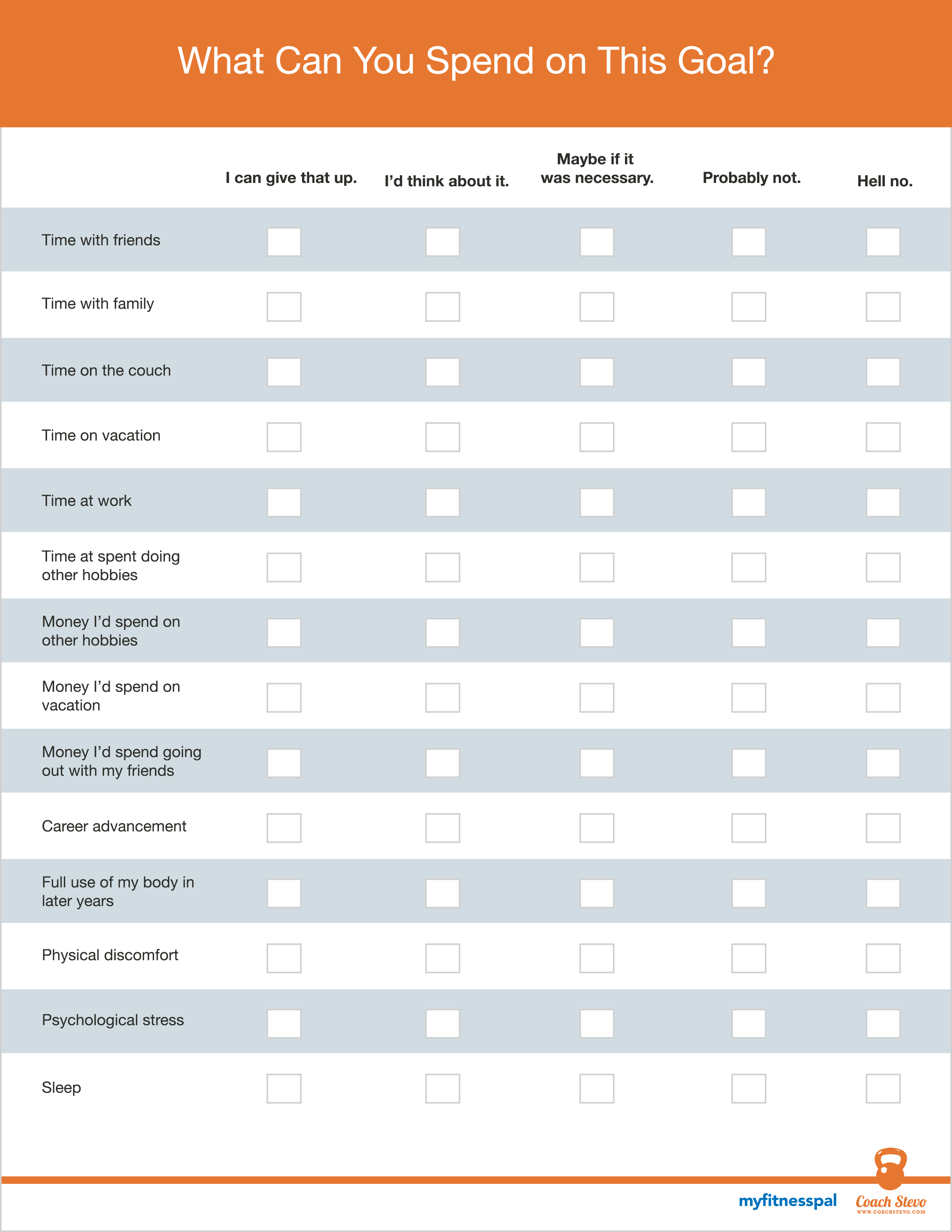
So, to do that, I use my priority grid:

Coach Stevo Priority Grid4

There are no wrong answers or minimum scores. In fact, the scores don't even matter. I don't even add them up. The only thing that matters to me in this initial assessment is that you take the time to think about and prioritize your answers. What matters is not the answers, but the thought that goes into them.

Most of what holds us back from getting the things we want is not that we don't want them enough, but that we're afraid that trying might not be worth it. So take the time to think about what you're willing to risk, and ask yourself, "What's the worst that could happen?"


Previous PostPostingan Lama Beranda
Related Posts Plugin for WordPress, Blogger...